

Workplace noise is one of the most common occupational health hazards in Malaysia, particularly in industries that operate heavy machinery, manufacturing equipment, compressors, metal fabrication processes, construction activities, and boiler systems.
According to the Department of Occupational Safety and Health (DOSH), excessive occupational noise exposure can contribute to noise-induced hearing loss (NIHL), one of the most frequently reported occupational health conditions in industrial workplaces.
To help protect employees and manage workplace noise hazards, employers may need to assess noise exposure levels and implement appropriate control measures in accordance with the Occupational Safety and Health (Noise Exposure) Regulations 2019.
This article explains what a noise risk assessment is, why it is important, and how it supports workplace safety and regulatory compliance.
What Is a Noise Risk Assessment?
A noise risk assessment is a structured process used to identify workplace noise sources, evaluate employee exposure to noise, and determine whether there are potential risks to employee health and safety.
The assessment helps employers understand:
- Noise levels generated by machinery and work processes
- Areas where excessive noise exposure may occur
- Employee exposure duration and patterns
- Potential risks of hearing damage
- Whether additional control measures may be required
Qualified assessors typically use specialised equipment such as sound level meters and personal noise dosimeters to collect workplace noise exposure data for evaluation.
The results are then compared against applicable exposure limits under Malaysian occupational safety regulations.
Why Is Noise Risk Assessment Important Under DOSH Requirements?
Malaysia’s Occupational Safety and Health (Noise Exposure) Regulations 2019 were introduced to strengthen protection against occupational noise exposure and replaced the earlier Factories and Machinery (Noise Exposure) Regulations 1989.
The regulations require employers to identify and manage workplace noise hazards where employees may be exposed to excessive noise levels.
Under the regulations:
- The action level is 82 dB(A) over an 8-hour working period
- The permissible exposure limit is 85 dB(A) over an 8-hour working period
- Maximum sound pressure level should not exceed 115 dB(A)
- Peak sound pressure should not exceed 140 dB(C)
Where workplace noise exposure reaches or exceeds the applicable thresholds, employers may need to implement additional measures such as noise control, hearing protection, employee training, and hearing conservation programmes.
Industries That Commonly Experience Occupational Noise Exposure
Industries that commonly experience occupational noise exposure include:
- Manufacturing factories
- Boiler and pressure vessel facilities
- Metal fabrication plants
- Construction sites
- Engineering workshops
- Oil and gas facilities
- Logistics and warehousing operations
- Processing and production plants
Machinery such as compressors, pumps, turbines, grinders, stamping machines, generators, and pneumatic tools are common contributors to elevated workplace noise levels.
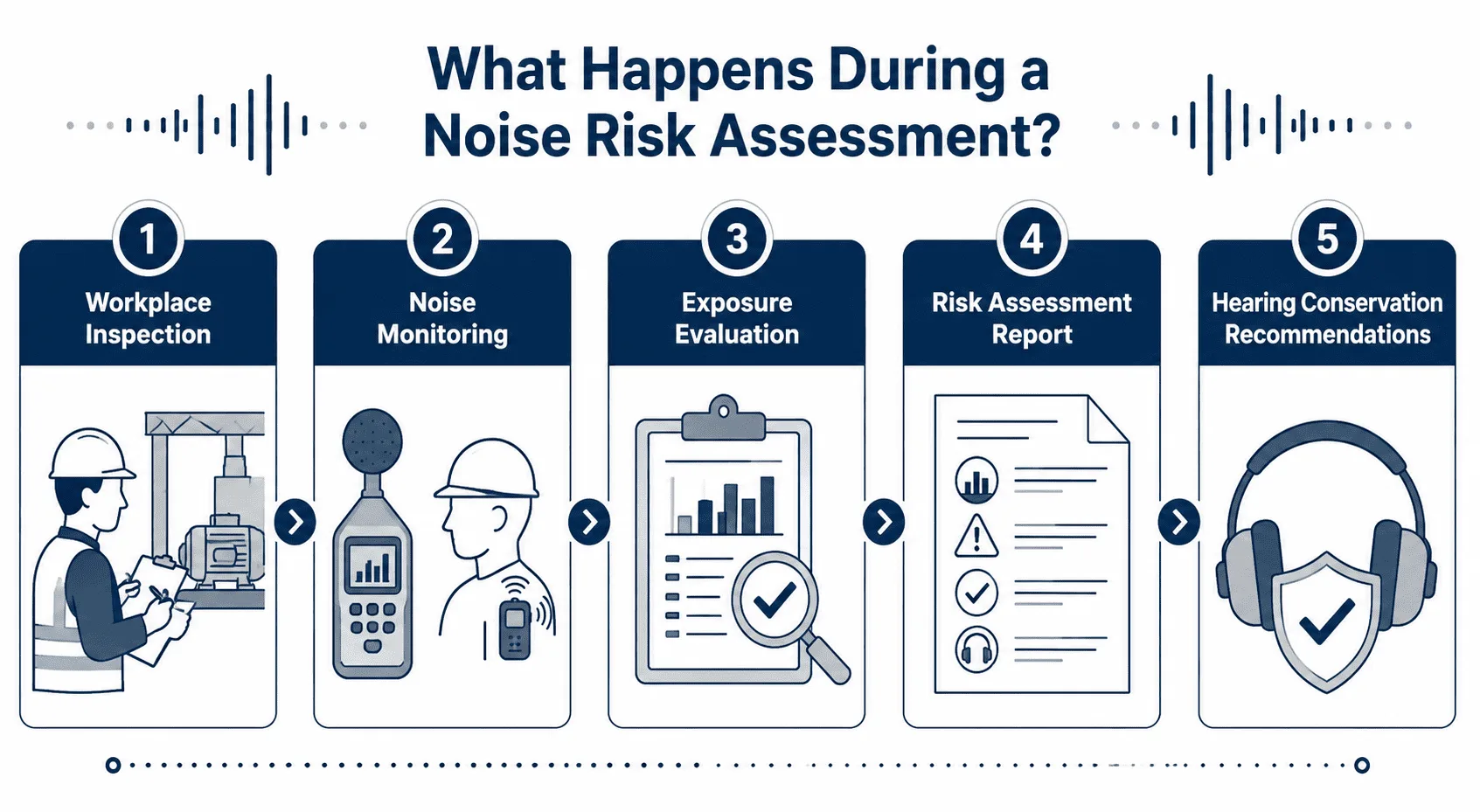
What Happens During a Noise Risk Assessment?
A professional noise risk assessment in Malaysia usually involves several stages to ensure accurate measurements and regulatory compliance.
Workplace Inspection
The assessor reviews workplace activities, equipment, operational processes, and employee work areas to identify potential noise sources.
Noise Monitoring
Specialized instruments are used to measure sound pressure levels in different work areas.
Personal dosimeters may also be attached to workers to monitor actual daily exposure levels throughout their shifts.
Noise Monitoring
Specialised instruments such as sound level meters are used to measure workplace noise levels across different areas.
Personal noise dosimeters may also be used to measure actual employee exposure during normal work shifts.
Exposure Evaluation
The collected measurements are analyzed to determine whether workers are exposed beyond DOSH permissible limits.
Risk Assessment Report
A detailed report is prepared outlining:
- Workplace noise measurements
- Exposure findings
- Identified risks
- Compliance status (based on exposure levels)
- Recommended control measures
- Hearing conservation recommendations
Why Excessive Workplace Noise Is Dangerous
One of the challenges with occupational hearing loss is that it often develops gradually without obvious early symptoms.
Long-term exposure to excessive noise may lead to:
- Permanent hearing damage
- Tinnitus (ringing in the ears)
- Communication difficulties
- Reduced concentration
- Increased workplace accident risks
- Fatigue and stress
Excessive noise can also interfere with warning signals and communication, increasing the risk of workplace accidents.
Hearing Conservation Programs in Malaysia
When employees are exposed above regulated thresholds, employers may also need to establish a Hearing Conservation Program (HCP).
A hearing conservation program may include:
- Regular audiometric testing
- Employee noise awareness training
- Provision of hearing protection devices
- Workplace noise control measures
- Ongoing exposure monitoring
- Record keeping and compliance documentation
DOSH guidelines also emphasize maintaining proper monitoring records and conducting periodic reassessments where workplace conditions change.
Methods to Reduce Workplace Noise Exposure
After completing a noise risk assessment in Malaysia, businesses can implement several control measures to reduce employee exposure.
Engineering Controls
- Installing acoustic barriers
- Enclosing noisy equipment
- Using vibration dampening systems
- Replacing outdated machinery
Administrative Controls
- Rotating employees
- Limiting exposure duration
- Scheduling noisy operations strategically
Personal Protective Equipment (PPE)
- Ear plugs
- Ear muffs
- Custom hearing protection devices
Preventive Maintenance
Poorly maintained machinery often produces higher noise levels. Regular servicing helps reduce unnecessary sound exposure.
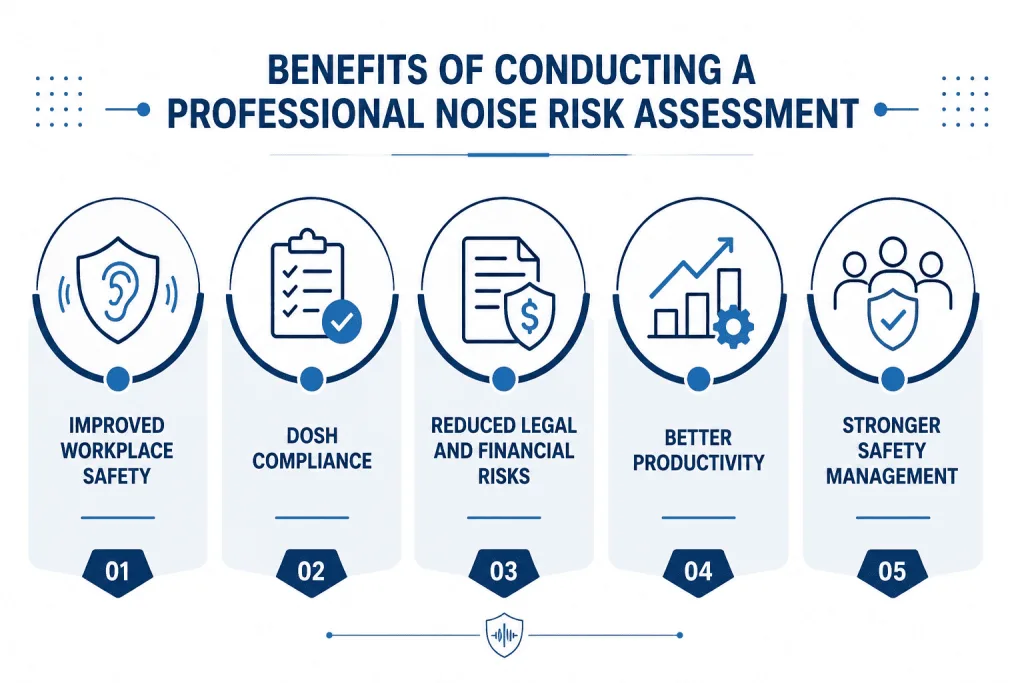
Benefits of Conducting a Professional Noise Risk Assessment
Conducting regular workplace noise assessments provides several operational and compliance advantages.
Improved Workplace Safety
Employees are better protected from occupational hearing damage and noise-related risks.
DOSH Compliance
Businesses can demonstrate compliance with Malaysian occupational safety regulations.
Reduced Legal and Financial Risks
Proper documentation and preventive measures help reduce enforcement risks, claims, and operational disruptions.
Better Productivity
Lower workplace noise levels improve communication, concentration, and employee comfort.
Stronger Safety Management
A proactive safety culture improves operational reliability and employee confidence.
Trusted Noise Risk Assessment Services in Malaysia
TS Multitech provides industrial safety and compliance support for workplaces such as factories, engineering facilities, boiler operations, and industrial sites across Malaysia.
Our services support businesses by helping them understand workplace noise conditions and improve safety practices through practical assessment and recommendations.
We assist with:
- Workplace noise monitoring and evaluation
- Understanding DOSH noise exposure requirements
- Practical recommendations for noise control improvements
- Support for industrial and engineering environments
- Documentation and safety reporting support
By combining technical understanding with industry experience, TS Multitech supports companies in improving workplace safety standards and managing occupational noise risks effectively.
Protect Your Workplace with Professional Noise Risk Assessment Services
Excessive workplace noise can lead to hearing damage, safety risks, reduced productivity, and non-compliance with DOSH regulations. Conducting a professional noise risk assessment in Malaysia helps businesses identify hazardous exposure levels and implement effective control measures before serious issues arise.
Contact TS Multitech today to schedule a professional noise risk assessment and improve workplace safety compliance for your business.
Conclusion
A professional noise risk assessment in Malaysia is an important part of workplace safety and occupational health management in Malaysia. Under DOSH regulations, employers are responsible for identifying and managing workplace noise exposure to protect employees from long-term hearing damage.
Through proper assessment and control measures, businesses can reduce occupational health risks, improve workplace safety, and support compliance with regulatory requirements.
Industries operating machinery, industrial processes, and high-noise environments should prioritise regular noise evaluation as part of their overall safety management strategy.
Frequently Asked Questions (FAQs)
What is Noise-Induced Hearing Loss (NIHL)?
Noise-Induced Hearing Loss (NIHL) is permanent hearing damage caused by prolonged exposure to excessive noise levels. It typically develops gradually and may not be noticeable in the early stages.
What is the DOSH action level for workplace noise?
The DOSH action level is 82 dB(A) over an 8-hour working period under the Occupational Safety and Health (Noise Exposure) Regulations 2019.
What is a Hearing Conservation Programme?
A Hearing Conservation Programme is a workplace safety programme that may include noise monitoring, employee training, hearing protection, audiometric testing, and ongoing exposure management.
What equipment is used during noise monitoring?
Common equipment includes sound level meters and personal noise dosimeters used to measure workplace noise levels and employee exposure.
Can workplace noise affect safety as well as hearing?
Yes. Excessive noise can interfere with communication, warning signals, concentration, and situational awareness, which may increase workplace safety risks.
Disclaimer
The information provided in this article is for general informational purposes only. While TS Multitech Sdn Bhd aims to ensure the content is accurate and up to date at the time of publication, we do not guarantee its completeness, reliability, or absolute accuracy.
This article should not be considered as legal or regulatory advice. For official requirements, interpretations, and enforcement of occupational safety regulations, please refer directly to the Department of Occupational Safety and Health (DOSH) Malaysia or consult qualified and certified safety professionals.